
The Leadership Triangle: Do the work only you can do
In January this year, a team of engineers was camped out in Building 92 on Microsoft's Redmond campus. They were in a race and they were behind. Competing teams at Google, Anthropic, and Meta were moving fast, and Microsoft, despite having taken an early lead in AI, was playing catch-up.
Then their CEO walked in.
He showed up not to deliver a pep talk. Not to review a slide deck. Not to remind them how important their work was. Satya Nadella walked in to show them something he had built.
He opened his laptop and demonstrated an application he called "Chain of Debate,” which is a system for coordinating multiple AI agents working together. He hadn't asked someone to build it for him. He had built it himself, using vibe coding, a method that allows anyone to create working software by describing what they want in plain language and letting an AI tool generate the code. No traditional programming required.¹ (“Anyone” includes me: I am vibe coding our FastTrack™ AI-Enhanced Strategic Planning & Implementation System.)
The room noticed. According to Jacob Andreou, the executive vice president leading Microsoft's Copilot product, the engineers traded the kind of looks that pass between people who suddenly realize the new guy can actually play. "That set the tone for how hard the team was going to push," Andreou recalled. "He was in the room with folks, like over their shoulder, there with his machine out. Watching the boss get such excitement out of building new things inspired the team."¹
A CEO writing code?
You might ask: How does the CEO of a $3 trillion company find time to write code?
He made room for it. In the months prior, Nadella had deliberately handed off operational responsibilities, delegating day-to-day duties so he could focus his personal attention on AI product development. He began showing up regularly in an internal channel with roughly 100 senior engineers. He led weekly product reviews. He recruited top talent personally.² He decided that the most important thing he could do for Microsoft's future was not to manage its present, and he restructured his own time accordingly.³
Nadella has been direct about what he believes this moment requires of leaders. "Intelligence has been commoditized when CEOs can start vibe coding," he said at Microsoft's 50th anniversary celebration. "But in all seriousness, this is not just a cool party trick. It's transformational. It's empowering. It's unleashing human ambition."⁴
He wasn't just talking about other CEOs. According to Fortune, Nadella's prototype served as a model for features that eventually made their way into Copilot Tasks, Microsoft's AI personal assistant, which shipped six weeks later.¹
Most leadership lessons come from a distance — a biography, a case study, a keynote story. This one is immediate, documented, and specific. And it raises a question worth pondering: What exactly did Nadella do that made it so effective?
He didn't just execute a task. He didn't just invest in his people. And he didn't simply announce a strategy.
He did all three — simultaneously, and deliberately.
He got his hands on the work, so his team could see that the direction he was pointing wasn't theoretical. He stayed in the room with his people, so they felt the weight of his belief in what they were doing. And every choice he made, from the delegation of his operational duties and the restructuring of his calendar to the decision to show up in that room with something he had personally built, had a clear strategic purpose: to signal, unmistakably, where Microsoft needed to go.
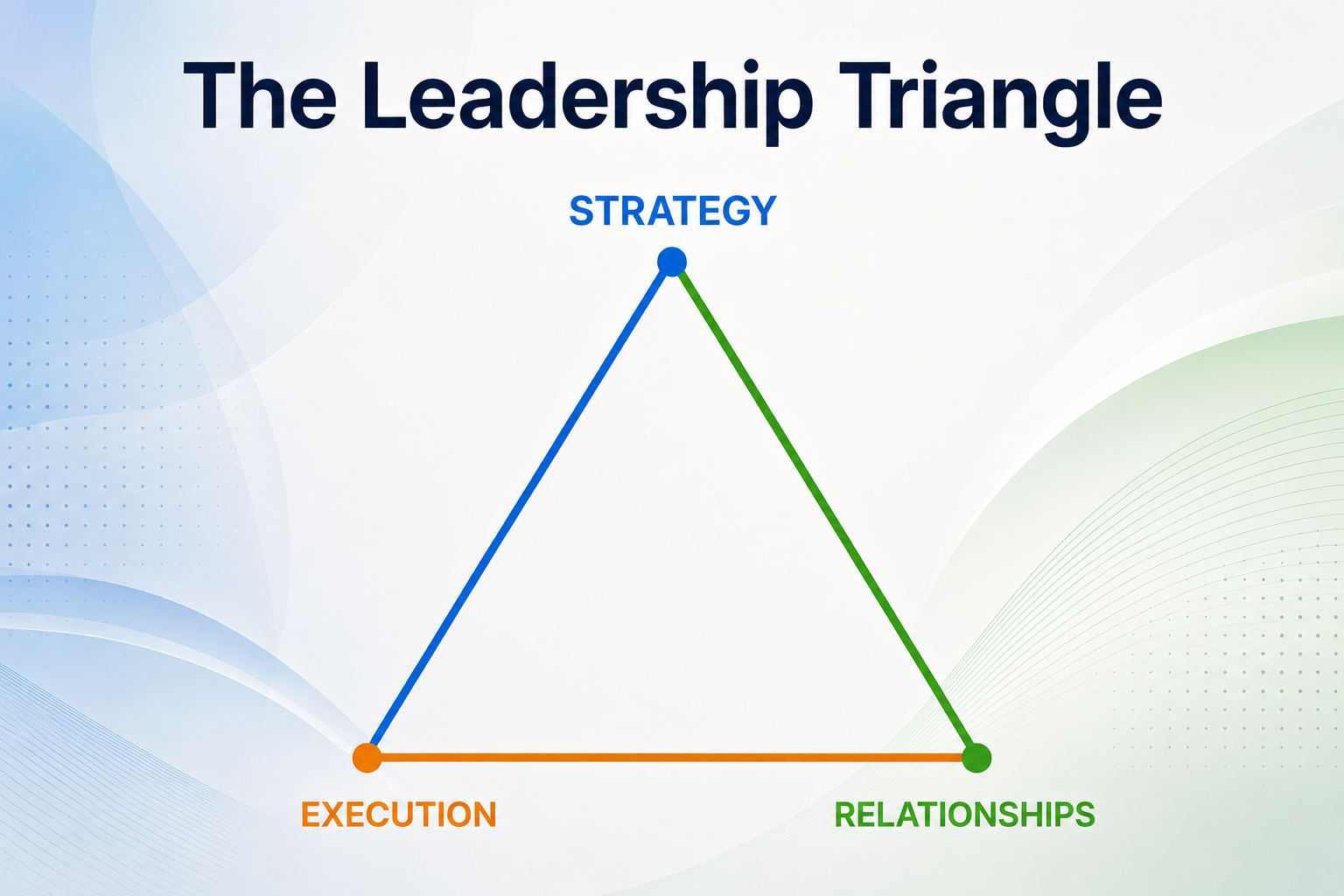
The Leadership Triangle
That is not one kind of leadership. It is three working together, in the hands of someone who understood how to use all of them.
This raises a larger question: What does it actually mean to lead at that level? And how does a leader get there?
Most leadership books would describe Nadella's actions in different ways. Some would say he demonstrated authentic leadership. Others would point to transformational leadership, servant leadership, adaptive leadership, or situational leadership. Each of those theories helps explain what happened.
But none of them fully explains why his actions were so effective. The reason is simple. Most leadership theories ask: "How should a leader lead?" The more important question for the CEO, C-Suite member, general manager, owner, executive director or partner to answer is different:
“What is my unique role?”
From my CEO/C-Suite/owner experience and work with all sorts of organizational leaders, I have come to believe that the answer begins with recognizing that organizational leadership operates in three distinct dimensions.
The first is execution. Execution creates value. It turns ideas into products, services, and results. Execution is largely linear and is concerned with today’s work. You identify the task, complete it, and move to the next. It is focused primarily inside the organization, and the time horizon is now or in the short term.
The second is relationships. Relationships amplify value. No organization succeeds through execution alone. Organizations succeed through people. Leaders recruit, align, and build trust with employees, customers, partners, suppliers, investors, and others whose support determines success. Relationships are multidimensional and more complex than tasks because people influence one another in countless ways, both inside and outside the organization
The third is strategy. Strategy sustains value. It introduces something fundamentally different: Time. Execution asks what we should do today. Relationships ask who must be engaged. Strategy asks what the organization must be tomorrow. The strategy dimension calls leaders to think beyond today's work and today's relationships, to look outward, asking how customers, competitors, technology, regulation, and other external forces are shaping the organization's future. The external environment becomes the starting point for deciding what the organization needs to become. Questions include:
Where is the market going?
What capabilities do we need to build?
What opportunities are emerging?
What threats are coming?
How should we position the organization for the future?
These three dimensions aren’t alternatives. They are complementary. Every organizational leader must operate in all three dimensions of The Leadership Triangle. What changes as responsibility increases is not whether these dimensions matter. It’s the relative emphasis placed on each.
The Leadership Shift
As someone advances, their center of gravity has to move:
Individual contributors naturally spend most of their day executing tasks.
Managers devote increasing attention to coaching and relationships while remaining tied to execution.
Organizational leaders (CEOs, founders, executive directors, or partners) still value execution and relationships, but must concentrate primarily on strategic direction—because that responsibility cannot be delegated.
Execution never stops mattering, and relationships never stop mattering. But the organization's future is uniquely the leader's job.
That is why Nadella’s story is so instructive. He didn't write code because Microsoft needed another developer; he did it to signal where the company had to go. He deliberately used execution to strengthen relationships in service of strategy.
That’s The Leadership Shift.
Knowing that these three dimensions exist doesn't mean a leader naturally moves between them.
Michael Gerber, in The E-Myth Revisited, observed that most small business owners are really technicians who had an entrepreneurial seizure.⁵ They were people who were good at doing the work and assumed that being good at the work meant they could run a business built around it. Gerber's famous distinction between working in the business and working on the business captured something many leadership books miss: The shift from execution to strategy isn't instinctive. It runs against the habits that made someone successful in the first place.
The same pattern plays out at every level of organizational leadership. The individual contributor who becomes a manager often keeps doing the work because doing the work is what earned them the promotion. The manager who becomes an executive keeps managing people because that's where their confidence lives. Each level of advancement calls for a shift in emphasis, and each shift requires letting go of something that felt like the job.
That’s why so many capable people plateau. It isn't a lack of talent. It's a tracking error: applying yesterday's lens to today's responsibility.
To reiterate: Satya Nadella didn't return to coding because he was stuck at the execution level. He returned deliberately, strategically, in service of a purpose only he could see. That's the difference. For emphasis, I’ll say it again: He used execution to strengthen relationships in service of strategy.
The framework is simple. The harder work is honest self-assessment and then making the shift: Where are you actually spending your time? Is that where your organization needs you most? If not, then what do you need to do to shift?
Sources
¹ "Microsoft Lost Its Way in the AI Race. Can Copilot Get It Back on Course?" Fortune, May 21, 2026.
² "Nadella Takes Direct Control of Microsoft AI." Yahoo Finance, reporting on The Information, December 24, 2025.
³ "Nadella Blogs About AI Slop." PPC.land, January 2, 2026.
⁴ "Satya Nadella on Microsoft's 50 Years: 'Intelligence Has Been Commoditized When CEOs Can Start Vibe Coding.'" Storyboard18, April 7, 2025.
⁵ Michael E. Gerber, The E-Myth Revisited: Why Most Small Businesses Don't Work and What to Do About It (HarperCollins, 1995).