

Strategic Thinking & Strategic Action
Fostering strategic thinking and strategic action by organizational leaders since 2007.
Archive
- October 2026
- September 2026
- August 2026
- July 2026
- June 2026
- April 2026
- March 2026
- February 2026
- January 2026
- December 2025
- November 2025
- October 2025
- August 2025
- July 2025
- June 2025
- May 2025
- April 2025
- March 2025
- February 2025
- January 2025
- December 2024
- November 2024
- October 2024
- August 2024
- July 2024
- June 2024
- May 2024
- April 2024
- February 2024
- January 2024
- December 2023
- November 2023
- October 2023
- July 2023
- August 2021
- April 2021
- March 2021
- February 2021
- November 2020
- October 2020
- September 2020
- July 2020
- June 2020
- May 2020
- March 2020
- October 2019
- September 2019
- July 2019
- April 2018
- January 2018
- December 2017
- November 2017
- October 2017
- September 2017
- August 2017
- January 2017
- December 2016
- November 2016
- October 2016
- September 2016
- August 2016
- February 2016
- October 2015
- March 2015
- November 2014
- October 2014
- September 2014
- July 2014
- May 2014
- March 2014
- February 2014
- December 2013
- September 2013
- August 2013
- March 2013
- February 2013
- December 2012
- October 2012
- June 2012
- May 2012
- March 2012
- February 2012
- January 2012
- December 2011
- November 2011
- October 2011
- September 2011
- August 2011
- June 2011
- May 2011
- April 2011
- March 2011
- February 2011
- April 2010
- October 2009
- June 2009
- May 2009
- April 2009
- March 2009
- February 2009
- May 2008
- February 2008
- August 2007
-
Action-oriented bias
- Nov 17, 2017 Trump trap: Action-oriented bias Nov 17, 2017
-
Approach-avoidance
- Sep 21, 2016 Approach or avoid? Sep 21, 2016
-
Bell curve bias
- Mar 28, 2020 We are biased by the bell curve Mar 28, 2020
-
Business model
- Aug 27, 2025 Redesign your business like an architect (so it finally fits your vision) Aug 27, 2025
-
Choice
- Oct 5, 2016 Managing choice Oct 5, 2016
-
Coaching
- Apr 20, 2026 Help is on the way! Apr 20, 2026
- Jan 7, 2025 Pick the best: Don’t let the bad drive out the good Jan 7, 2025
- Jan 22, 2024 Coaching and change Jan 22, 2024
- Apr 1, 2021 Let’s not be complacent about our ignorance! Apr 1, 2021
- Mar 10, 2021 So much can go wrong. Here’s how to make it go right. Mar 10, 2021
- Mar 10, 2021 Why settle? Go for the gold! Mar 10, 2021
-
Consensus
- Dec 6, 2016 No consensus for consensus Dec 6, 2016
-
Decision biases cases
- Oct 19, 2020 Short-sighted thinking: The case of the “hot new smartphone” Oct 19, 2020
- Sep 10, 2020 Changing our thinking to feel better. Yes, we do that! Sep 10, 2020
- Oct 24, 2019 Remember, history is written by the survivors Oct 24, 2019
- Oct 22, 2019 Beliefs about a group matter Oct 22, 2019
- Oct 15, 2019 Not knowing we don’t know Oct 15, 2019
- Sep 19, 2017 Case 12: Not missing the opportunity to lose billions Sep 19, 2017
- Aug 29, 2017 Case 11: Getting bitten by not seeing it Aug 29, 2017
- Aug 29, 2017 Case 10: When what worked didn’t work Aug 29, 2017
- Aug 28, 2017 Case 9: The climbers who perished by succeeding Aug 28, 2017
- Aug 28, 2017 Case 8: No accounting for incompetence Aug 28, 2017
- Aug 16, 2017 Case 7: Blind or incompetent? Perhaps both… Aug 16, 2017
- Aug 16, 2017 Case 6: Seeing what he wanted to see Aug 16, 2017
- Aug 13, 2017 Case 5: Getting burned by past successes Aug 13, 2017
- Aug 2, 2017 Case 4: I’m the boss, so I am right! Aug 2, 2017
- Aug 2, 2017 Case 3: The experts were wrong Aug 2, 2017
- Aug 2, 2017 Case 2: The battle that didn’t go as expected Aug 2, 2017
- Dec 12, 2016 Failure without facilitation: The French Canal Disaster Dec 12, 2016
- Oct 26, 2015 Decision traps, flaws and fallacies: Learn from my unexpected big decision Oct 26, 2015
-
Decision making
- Nov 6, 2024 Rise of the poker pros: 10 lessons for great success Nov 6, 2024
- Jan 5, 2024 What’s your magic number? Jan 5, 2024
- Oct 9, 2023 AI revisited: Will it ever make perfect decisions? Oct 9, 2023
- Sep 4, 2019 “The instant of decision is madness” Sep 4, 2019
- Apr 23, 2018 Despite our growing ignorance, we must decide Apr 23, 2018
- Apr 12, 2018 Can “Big Data” deliver “the right decision”? Apr 12, 2018
- Jan 18, 2018 The worst accident: “We’re going!” Jan 18, 2018
- Mar 8, 2015 10 surprising mental traps: Why we make bad decisions Mar 8, 2015
- Mar 10, 2014 Often wrong but never in doubt Mar 10, 2014
-
Decision making biases
- Mar 10, 2021 So much can go wrong. Here’s how to make it go right. Mar 10, 2021
-
Evidence
- Dec 16, 2016 Misuse of evidence can zap your strategy Dec 16, 2016
-
Evolution
- Aug 6, 2016 Smart phones on the savannah Aug 6, 2016
-
Gratitude
- Oct 25, 2017 Thank you for our connection Oct 25, 2017
-
Group decisions
- Nov 15, 2016 #2 error: Not using the group advantage Nov 15, 2016
- Oct 22, 2015 Open up your thinking: Make better decisions in a group process Oct 22, 2015
-
Leadership
- Sep 15, 2026 The one job nobody else has Sep 15, 2026
- Jun 29, 2026 The Leadership Triangle: Do the work only you can do Jun 29, 2026
- Nov 14, 2016 #1 error: The leader problem Nov 14, 2016
- Feb 1, 2016 Leaders who mislead: A tale of two movies Feb 1, 2016
-
Pre-mortem
- Sep 12, 2016 Thinking “as if” Sep 12, 2016
-
Risk
- Jun 9, 2020 The Black Swan and us Jun 9, 2020
- Jan 10, 2017 The risk of ignoring risk Jan 10, 2017
- Oct 14, 2016 Risk and regret Oct 14, 2016
-
Strategic planning
- Oct 12, 2026 What’s coming at you? Oct 12, 2026
- Sep 30, 2026 “The Former Rabbit” has 4 questions for you Sep 30, 2026
- Aug 27, 2026 Great strategy? Too bad, you fail. Aug 27, 2026
- Jul 14, 2026 The times they are a-changin’ Jul 14, 2026
- Feb 16, 2026 The Fake-Out: Your brain thinks you’re winning but you’re already losing Feb 16, 2026
- Feb 14, 2026 Navigating a time of seismic change Feb 14, 2026
- Dec 15, 2025 Here’s the recipe for a great New Year for your business Dec 15, 2025
- Nov 19, 2025 No matter the uncertainty, plan we must Nov 19, 2025
- Jul 16, 2025 Why strategy fails… and how to make it succeed Jul 16, 2025
- Jun 27, 2025 New! FastTrack™ for supercharged strategic planning Jun 27, 2025
- Jun 19, 2025 Plans can go astray. Check your course and expect the unexpected Jun 19, 2025
- May 26, 2025 Self doubt and strategic planning May 26, 2025
- Jan 4, 2025 California High Speed Rail to nowhere: Lessons for implementing our plans Jan 4, 2025
- Dec 17, 2024 Why New Year’s resolutions fail: The problem of implementation Dec 17, 2024
- Nov 10, 2024 Are you ready to bat? Nov 10, 2024
- Oct 9, 2024 Drift and big change challenge our success Oct 9, 2024
- Aug 19, 2024 Get real when you plan! Aug 19, 2024
- Apr 10, 2024 Bridge the strategy gap Apr 10, 2024
- Feb 23, 2024 Don't waste your time planning, unless... Feb 23, 2024
- Dec 18, 2023 The secret sauce of successful plan implementation Dec 18, 2023
- Nov 20, 2023 How to build commitment to change, revisited Nov 20, 2023
- Oct 3, 2023 Success Starts With a Big Vision Oct 3, 2023
- Aug 24, 2021 Sometimes you get what you need Aug 24, 2021
- Feb 25, 2021 Do you measure up? Feb 25, 2021
- Jul 28, 2020 Forget business as usual Jul 28, 2020
- Oct 9, 2014 What’s driving your organization? Oct 9, 2014
- Feb 20, 2014 This is not an infomercial Feb 20, 2014
- Feb 11, 2014 The Big Fail Feb 11, 2014
- Mar 12, 2013 Parsimony and planning Mar 12, 2013
-
Strategic thinking
- Feb 11, 2025 What to do when disaster ensues Feb 11, 2025
- Feb 27, 2024 Desirable difficulties Feb 27, 2024
- Jan 13, 2024 Business model question: Produce or provide? Jan 13, 2024
- Jan 5, 2024 What’s your magic number? Jan 5, 2024
- Jul 5, 2023 Think wide to succeed: How will you compete? Jul 5, 2023
- Mar 25, 2014 Flight 370 and strategic thinking Mar 25, 2014
-
Strategy
- Sep 17, 2026 What if your strategy could talk back? Sep 17, 2026
- Apr 25, 2026 Are you lugging rocks uphill? Apr 25, 2026
- Mar 12, 2026 Not having a strategy is not a strategy Mar 12, 2026
- Oct 8, 2025 Will the new “big idea” go haywire? Oct 8, 2025
- Apr 23, 2025 Lead from strategy, don’t waste time Apr 23, 2025
- Mar 17, 2025 Are you getting your share? Mar 17, 2025
- Feb 24, 2025 Know who you are up against! Feb 24, 2025
- Jan 18, 2025 Be better than the competition Jan 18, 2025
- Jul 23, 2024 Your pricing says it all… But what does it say? Jul 23, 2024
- Jun 23, 2024 We are people, not transactions Jun 23, 2024
- May 22, 2024 Is excellence - or failure - ahead? Answer five questions to know May 22, 2024
- Apr 8, 2024 What do your customers expect? Apr 8, 2024
- Nov 13, 2023 Demand a great brand! Nov 13, 2023
-
Success
- Jul 24, 2019 22 principles I have learned from being an athlete Jul 24, 2019
-
Sunk cost fallacy
- Mar 21, 2015 Sunk cost fallacy: Throwing good money after bad Mar 21, 2015

“The Former Rabbit” has 4 questions for you
Do you have a plan for 2026? Written down, in your head, on a napkin somewhere? Anything counts.
Have you looked at the plan (if you have one) in the last 30 days? Made a single decision because of it?
If you just said "um...no" to having a plan or to referencing your plan. you're in good company. Most everyone has been there.
That gap between not having a plan and having a plan is real and consequencial. Without a plan, any outcome (or not getting any outcomes) is the result. If you are good with your life or at least your business life blowing around like a leaf in the breeze, that’s likely acceptible. But most of us want to go somewhere, usually somewhere better, and we are much more likely to get there with a plan rather than without one.
We don't plan because we know what's going to happen. We plan because we don't. And a plan only helps if it keeps up with what actually happens.
I have written scads about creating your plan. Peruse my blog and my first book, AHEAD: Strategy is the way to a better future. But that’s not what this post is about. This is about acting on your plan and adapting your plan.
I learned a lot about planning and acting on and adapting the plan the hard way. For many years, I was a short-track speedskater, a marathoner, an Ironman triathlete, and a running and triathlon coach. Sixty marathons. Ironman Canada year after year for 11 years. 100s of race plans. And plenty of race days that did not go according to the plan, at least according to my plan or my client’s plan for the day.
What if your strategy could talk back?
Good strategic thinking needs more than answers. It needs good questions. Over time.
What are you assuming? What might you be missing? Does your strategy really address the goal? What would have to be true for this to work?
Many strategies never get questioned. They are written, approved, and then left alone, as if putting them down settled the matter.
A strategy that could actually talk back, that continued to push on your assumptions instead of sitting quietly where you left it, would catch what a perfectly written plan never will: the moment it stopped being right.

The one job nobody else has
If you lead a business or nonprofit, you're responsible for something no one else in the organization is responsible for.
The whole thing. And where it's going.
Customers. Finances. Operations. People. Opportunities. Risks. The future. All of it lands on your desk eventually, and only your desk.
A customer needs something right now. An employee has a problem that can't wait until tomorrow. An opportunity shows up out of nowhere and has to be chased before it closes. The numbers need attention. Something unexpected happens, because something always does.
None of this is optional. It's the job. And most days, it's a full job on its own.
But while you're handling all of it, somebody still has to be thinking about where the organization is going. Not next week. Not this quarter's fire drill. Three years out. Five years out. The direction, not just the day. How to innovate. New products or services that will win you customers and revenue. How to stay relevant and profitable, or, if you are a nonprofit, how to deliver more on your mission

Great strategy? Too bad, you fail.
The problem is a good decision that isn't happening. That’s the Execution Gap. It’s why good strategy doesn’t get done.
The distance that matters isn't always between one strategy and a better one. It's often between what we decide we will do and what actually gets done. Deciding on a strategy isn't the same as executing it. "We're going to grow sales" or "We're launching the new service" are choices. They are not plans.
Strategy determines where you want to go. Execution determines whether you get there. Your strategy is not what you say is important. It's what you consistently turn into action and results.
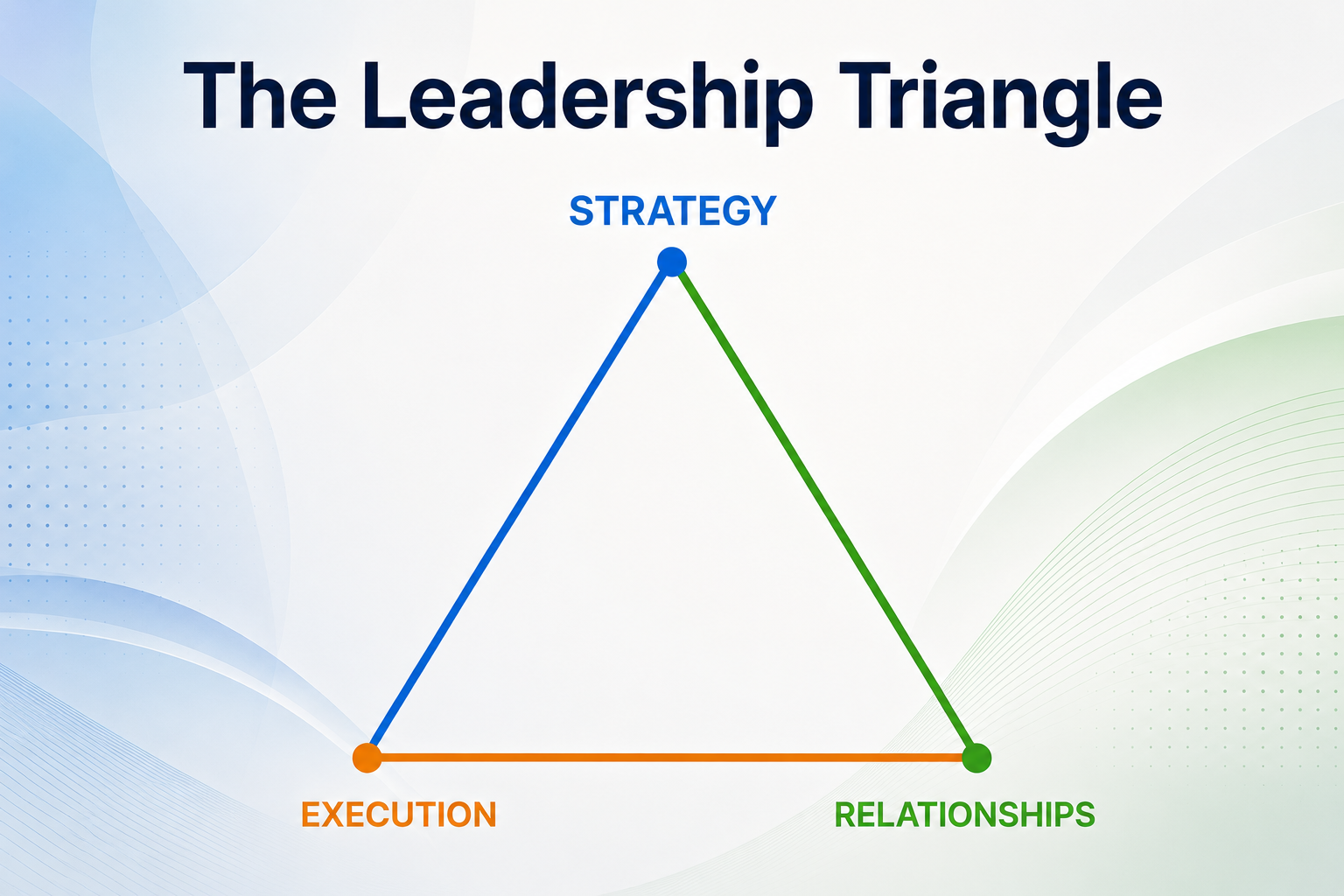
The Leadership Triangle: Do the work only you can do
In January this year, a team of engineers was camped out in Building 92 on Microsoft's Redmond campus. They were in a race and they were behind. Competing teams at Google, Anthropic, and Meta were moving fast, and Microsoft, despite having taken an early lead in AI, was playing catch-up.
Then their CEO walked in.
He showed up not to deliver a pep talk. Not to review a slide deck. Not to remind them how important their work was. Satya Nadella walked in to show them something he had built.
He opened his laptop and demonstrated an application he called "Chain of Debate,” which is a system for coordinating multiple AI agents working together. He hadn't asked someone to build it for him. He had built it himself, using vibe coding, a method that allows anyone to create working software by describing what they want in plain language and letting an AI tool generate the code. No traditional programming required.¹ (“Anyone” includes me: I am vibe coding our FastTrack™ AI-Enhanced Strategic Planning & Implementation System.)
The room noticed. According to Jacob Andreou, the executive vice president leading Microsoft's Copilot product, the engineers traded the kind of looks that pass between people who suddenly realize the new guy can actually play. "That set the tone for how hard the team was going to push," Andreou recalled. "He was in the room with folks, like over their shoulder, there with his machine out. Watching the boss get such excitement out of building new things inspired the team."¹

Help is on the way!
I grew up in a culture that expected you to deal with life and solve the problems thrown at you. No whining, don’t be vulnerable, make things work!
Luckily, societal attitudes evolved and I married a clinical social worker who adjusted my thinking. I personally received clinical and non-clinical guidance from counselors and coaches. Mentors and friends helped keep me on a solid path and accountable for good decisions and execution.
Being a business coach who spends 10 hours or so a week in session with clients is a far cry from the life I would have envisioned for myself when I was playing cowboys and Indians or dealing with teenage angst. But that I am able to be of such ongoing help to business owners and leaders is a real privilege. I am proud of my clients who have taken what once was a taboo step: Opening up their businesses and their minds to let me in so that they can share and get expert third-party insight on how to make their businesess better in the ways that they want them to be better.
Not having a strategy is not a strategy
After more than four decades working with organizations on strategy, one pattern still surprises me. Many organizations operate without a current strategic plan. Others technically have one, but it sits somewhere in a document or slide deck and does not meaningfully guide everyday decisions.
From the outside, these organizations often appear quite busy and productive. People are working hard, customers are being served, and problems are being solved. Activity is constant and the organization rarely feels idle.
But something subtle is happening beneath the surface.
Decisions are made without a shared direction. Priorities shift depending on who speaks loudest or which issue appears most urgent. Projects are launched that may be worthwhile on their own but are not clearly connected to a broader future the organization is trying to create.
Over time the organization begins solving the same problems again and again. Leaders expend tremendous energy, but the progress achieved rarely matches the effort invested.
Eventually someone asks a question that experienced leaders recognize immediately:
Why does it feel like we are working harder every year but not moving forward as much as we should?
That question is often the signal that strategy has been neglected.

The Fake-Out: Your brain thinks you’re winning but you’re already losing
February is the most dangerous month on the strategic calendar.
In January we are hopped up on adrenaline from the New Year start. March brings the rush of the first quarter end. February? February is when we fake ourselves out.
Odds are you have been feeling productive. Your calendar is full. You are clearing your inbox, at least of the important current stuff. You are "in the swing of things."
But, look closely at what you are doing. You may just find a terrifying reality: Your actions aren't strategic. Most of what you are doing likely does not directly relate to executing your 2026 strategic business plan. You are just managing the rush of business and day-to-day processes. Nothing much has changed since 2025.
I hope this is not the case for you. Too many of us get sucked into (or never escape) the subtle mechanism of what's called the Implementation Gap. It doesn't announce itself with blaring trumpets; it hides behind our mask of "busy-ness."

Will the new “big idea” go haywire?
Artificial intelligence is the new “big idea.”
Every generation has one — the transformational concept that promises to change everything. Ours is AI. The promise is intoxicating: automate thought, create at scale, eliminate inefficiency, augment and/or even replace humans, and unlock new levels of intelligence.
The scale of the rush is staggering. Trillions of dollars are flowing into AI — not only into software startups but also into chip manufacturers, hyperscale data centers, and the immense energy infrastructure needed to power them. Nvidia, whose processors drive most of the world’s AI models, now hovers near a $4 trillion valuation, briefly surpassing both Apple and Microsoft as the world’s most valuable company. OpenAI, valued around $500 billion, is the most valuable private company in history. The tech giants — Microsoft, Alphabet, Amazon, and Meta — are each pouring tens of billions annually into AI research, infrastructure, and integration. The stock market is riding this wave of enthusiasm; entire national economies are now tethered to expectations that AI will deliver exponential returns.
If you listen to the music, it’s all promise and acceleration.
But wait — stop the music. Haven’t we heard this before?

Why strategy fails… and how to make it succeed
In the quest to achieve our vision, “Every organization and business leader has a strategic plan and they are executing their plan for greater success,” we have cataloged 16 causes of planning failure and suggested remedies. Here's our "watch out for it and what to do about it" list, designed to help leaders, owners, and professionals involved in strategic plan implementation assure that their efforts take the organization to the next level.

Are you getting your share?
If you are a fan of the television show Shark Tank, where wanna-be and true entrepreneurs make pitches for funding, you know the trap that some of the presenters fall into. Here’s how it might go.

Know who you are up against!
Part of understanding where your organization is headed is to identify with whom you are competing and will compete in the future. Competitors are a critical class of external actors. They shape the markets your organization serves. Their actions will affect your and contribute to the threats and opportunities that you face.
Your planning process needs to address your competition. Responding to, anticipating, and even surprising your competition are ripe considerations when you are developing strategies to get you to your goals and vision of great success.
A useful way to consider competitors is the degree to which they affect or can affect your organization, and to look at the degree to which your organization affects or can affect them. Competitors high on either measure, and especially on both measures, are important for both opportunistic and defensive reasons.

Be better than the competition
It’s a tough world out there! It’s likely, whether you recognize it or not, that you are in a cutthroat marketplace where some competitors resort to unethical tactics to gain an edge – lying, cheating, or even jeopardizing safety.
The side of business involving fierce competition is the “Red Ocean,” a concept popularized by W. Chan Kim and Renée Mauborgne in their book "Blue Ocean Strategy," published in 2005. “Red Ocean” is a metaphor for the "bloody" competition inherent in crowded markets, where businesses fiercely battle for market share.
This seemingly dystopian nightmare scenario is playing out in many markets today, involving large corporations and local businesses. From Volkswagen's emissions scandal to strip clubs blacklisting dancers, tales of "bad" competition expose the damaging consequences of unethical practices.
The good news? You don't have to compromise your integrity to succeed. You can thrive like the most sustainable businesses by being better, not worse, than your rivals.

Why New Year’s resolutions fail: The problem of implementation
Yesterday, New Year’s resolutions came to mind as I was writing year-end reports to my coaching clients.
A blog post on goal-setting and achievement that I wrote earlier this year, Don’t waste your time planning, unless…, cited research showing that 92% of people who make New Year’s resolutions never actually achieve them. While I recognize that what we resolve to achieve in the New Year can be a casual goal without a lot of commitment behind it, to me it seems silly to put a marker out there and then ignore it or only half-heartedly go after it.

Don't waste your time planning, unless...
I deal daily with clients setting goals and assessing goal achievement. That's at the heart of strategy implementation and client success.
My hard-earned guidance: Don't waste your time planning, unless you are prepared set and achieve goals.