
Help is on the way!

When I was a young lad, it was the time of the Western, of movies and TV shows that glamorized the cowboy, life on the frontier, and rugged individualism.
And in that era, seeing a therapist or counselor was widely seen as a sign of weakness, instability, or even moral failure. That certainly was my Dad’s attitude. My Mom, who had been an occupational therapist, kept her counsel: I suspect she disagreed with Dad, but she kept her opinion to herself. Dad, a Navy veteran, was inculcated like most other GIs in World War II: Veterans returning from the war were expected to simply readjust and move on. Admitting emotional difficulty was seen as soft or unpatriotic. The cultural message was largely: Handle your problems yourself, or keep them private.
Simply, I grew up in a culture that expected you to deal with life and solve the problems thrown at you. No whining, don’t be vulnerable, make things work!
Luckily, societal attitudes evolved and I married a clinical social worker who adjusted my thinking. I personally received clinical and non-clinical guidance from counselors and coaches. Mentors and friends helped keep me on a solid path and accountable for good decisions and execution.
Helping is a privilege
Being a business coach who spends 10 hours or so a week in session with clients is a far cry from the life I would have envisioned for myself when I was playing cowboys and Indians or dealing with teenage angst. But that I am able to be of such ongoing help to business owners and leaders is a real privilege. I am proud of my clients who have taken what once was a taboo step: Opening up their businesses and their minds to let me in so that they can share and get expert third-party insight on how to make their businesess better in the ways that they want them to be better.
In my business life, beyond being a business coach, I have been a journalist/editor, executive/leader in multiple organizations, a serial entrepreneur, and a consultant. In each of these roles others have helped me and my business endeavors grow and improve. In short, I would have been far less successful if it weren’t for help, structured and unstructured, from others.
Some months ago my coaching co-conspiritor Rod Bourn and I decided to offer several presentations highlighting the value of “real deal” business coaching and mentoring, in part because we were observing so many “bottom feeders, skimmers, and scam artists” in the business coaching world, making flashy promises and claims of quick fixes, those who call life coaching or motivational coaching or something other than business coaching “business coaching,” whose coaching credentials are hollow, missing, or misrepresented, who “don’t know net margin from a fishing net.” You can read my post protesting these posers here: Pick the best: Don’t let the bad drive out the good.
Clarity on the help available
Rod and I decided we needed to bring more clarity to the world of “business and business leader help” by drilling down on the virtures of business coaching, mentoring, and accountability. (This mix intentionally omits business consulting, which I have been engaged in for nearly 40 years, because it is essentially project-based problem solving or improvement and does not work through the owner/leader/executive/professional in the way that business coaching, mentoring, and accountability do.)
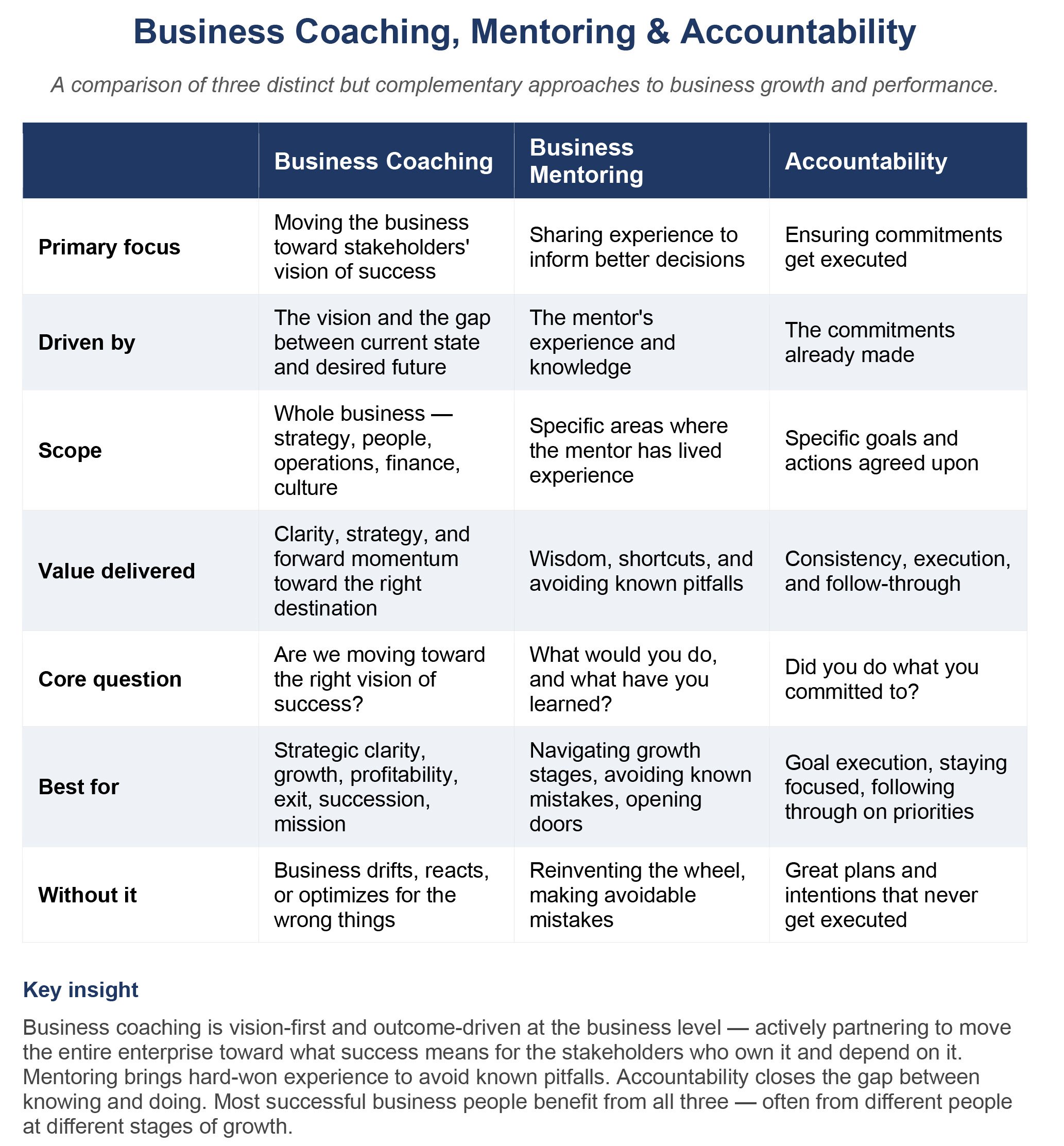
Here is our handout, which offers the essence of each approach.
Distinct orientations
The table above is clear — maybe deceptively so. In practice, the lines between coaching, mentoring, and accountability get blurry. A good business coach will sometimes draw on experience the way a mentor does and usually offers their clients accountability. A mentor will sometimes hold you accountable. And a trusted accountability partner will, over time, begin to see patterns in your behavior that lead to a more strategic conversation.
What the chart does capture is something important: these are three distinct orientations. Coaching is future-facing and vision-driven. Mentoring is experience-driven. Accountability is commitment-driven. Knowing which orientation you need at a given point in time — and finding the right person to provide it — is itself a form of business wisdom.
Rod and I have seen what happens when business owners try to get all three from one person who isn't equipped to provide them, or when they confuse a motivational speaker's weekend workshop with the sustained, structured work of real business coaching. The results are predictable: short-term energy followed by little change.
The common thread
Coaching, mentoring, and accountability all require you to be open. Open to honest feedback. Open to being challenged. Open to the possibility that the way you've been running your business — or your career, or your life — might not be the best path for where you want to go.
That kind of openness doesn't come naturally to many of us, especially those like me raised in the "handle it yourself" era I described earlier. It took me years, a good marriage, and more than a few humbling professional experiences to understand that seeking help isn't weakness. It's a positive strategy for greater success and happiness.
The most effective business owners I've worked with aren't necessarily those with the most talent or the best timing. They're the ones who have built a circle of trusted advisors — coaches, mentors, and accountability partners, as well as necessary specialists such as business attorneys and CPAs — and who engage with their circle in a disciplined and honest way.
The “help desk” is open!
If you recognize yourself in the "without it" column of the table above — drifting, reinventing the wheel, making plans that never quite get executed — I encourage you to ask yourself: What kind of help do I actually need right now? What help would do me the most good?
Strategic clarity? That's coaching. Hard-won experience in your specific growth stage? That's mentoring. Someone to make sure you actually do what you said you'd do? That's accountability.
You don't have to choose just one. Most successful business people, as the chart notes, benefit from all three — often from different people at different stages of growth.
Both Rod and I would be glad to talk through where you are and what might help most. No flashy promises. No quick fixes. Just a real conversation about you and your business, where you want it to go, and what it will take to get there.
Because helping — real helping — is a privilege. And it starts with a conversation.