
The one job nobody else has

If you lead a business or nonprofit, you're responsible for something no one else in the organization is responsible for.
The whole thing. And where it's going.
Customers. Finances. Operations. People. Opportunities. Risks. The future. All of it lands on your desk eventually, and only your desk.
Today has a way of taking over
A customer needs something right now. An employee has a problem that can't wait until tomorrow. An opportunity shows up out of nowhere and has to be chased before it closes. The numbers need attention. Something unexpected happens, because something always does.
None of this is optional. It's the job. And most days, it's a full job on its own.
But while you're handling all of it, somebody still has to be thinking about where the organization is going. Not next week. Not this quarter's fire drill. Three years out. Five years out. The direction, not just the day. How to innovate. New products or services that will win you customers and revenue. How to stay relevant and profitable, or, if you are a nonprofit, how to deliver more on your mission.
The job inside the job
Here's the problem: Nobody assigns that second job. Unless you put it there, there's no meeting on your calendar labeled "Think about the future of the organization." No one taps you on the shoulder to remind you it's still your responsibility, even when the urgent stuff is loud and the important stuff is quiet.
Your team is looking to you to handle today's problems. That's reasonable. It's also not the whole job.
I am working with an owner of a retail business who was, by his own account, running his business at the operator level. Every day was managing staff, making point-of-sale system decisions, handling inventory calls, responding to customer emails, and so on, the kind of work that has to get done and that he is good at. But that meant no one in the organization was working on the roles, systems, and separation of duties that would let the business run without him standing in the middle of every decision.
And it meant something else, too: There was no time left for him to actually think strategically, let alone plan and act strategically. The operator's job was so full that the owner's job wasn't just under-resourced. It wasn't happening at all.
The fix isn't working harder at the operator's job. It's carving out time to do the owner's job: Stepping back to think about where the business needs to go, and then acting on it, building the structure that lets the organization function and grow beyond whatever he personally has bandwidth for today.
The whole job includes making sure that five years from now the organization is stronger, not just older. That takes deliberate, consistent attention, and deliberate, consistent attention doesn't happen by accident. It happens when you protect time for it the same way you would protect time for a critical customer meeting or a make-or-break negotiation.
Shifting requirements
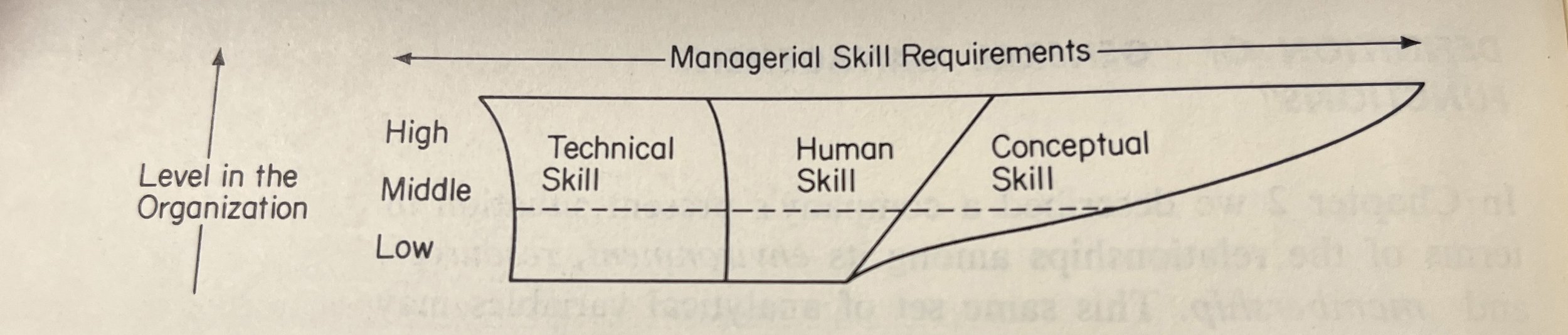
In a classic Harvard Business Review article on administrative effectiveness, Robert Katz described the skills a manager needs as technical (what is done), human (how it is done), and general management/conceptual (why it is done). 1 Conceptual skill is the ability to see the enterprise as a whole, recognizing how the various functions of the organization depend on one another, and how changes in any one part affect all the others. Katz's research showed that as a leader moves up an organization, the need for conceptual skill rises sharply while the need for technical skill falls. At the top, conceptual skill, not technical skill, is what the role actually requires. He wrote in Management of the Total Enterprise, which was a text that guided my capstone strategy class at the University of Chicago many decades ago, that the leader’s “major requirement is for the conceptual ability to view the enterprise as a whole, in strategic terms.” 2
Looking through Katz’s lens, my retail owner client's problem isn’t a lack of skill. It’s that his role now calls for a different skill than the one he'd spent his career mastering. Nobody told him the requirements had shifted.
Nobody else is going to do this
Whether your organization is large or small, you can put together a team who can run operations. A financial person to watch the numbers. People to take care of customers as well as you can, if not better, because that is their primary focus. But whether they are staff, contractors, or AI agents, none of them will be positioned to see the whole organization and its future at the same time. That view, and the responsibility that comes with it, is yours alone.
I've written before about why that's true structurally, not just practically, in The Leadership Triangle: Execution and relationships can be shared out as an organization grows, but the strategy dimension only concentrates more as you take on more responsibility. It doesn't diffuse. It falls to you.
That's not a burden to resent. It's the actual job you signed up for when you decided to lead.
I feel this one myself. Client work can fill the day easily and it should. That's the reason Forrest Consulting exists right now. But I'm also building and marketing FastTrack™ 2.0, our complete system for developing and implementing strategy. That platform is the future of the business. If I only ever did the client work in front of me, FastTrack™ 2.0 would never exist. The two jobs don't compete for different hours by accident. I have to put one on the calendar on purpose, or the urgent one wins every time.
The organizations that pull ahead aren't the ones with leaders who are busier than everyone else. They're the ones led by people who found a way to keep doing today's work while still making room, on purpose, for the work only they can do: Thinking about where the whole thing is headed, and making sure it gets there.
_____________________________________
If you'd like a way to make that second job easier to get a hold on, FastTrack™ 2.0 is built for exactly this problem. It walks you and your team through developing and executing real strategy, so the work of thinking about where your organization is going doesn't just live in your head between fire drills. Take a look at fasttrackplanning.com.
1 Robert L. Katz, “Skills of an Effective Administrator,: Harvard BUsiness Review, Vol 33, No. 1 (January-February 1955).
2 Robert L. Katz (1970). Management of the Total Enterprise. Englewood Cliffs, New Jersy: Prentice- Hall, Inc.